Why Business Owners Avoid Their Numbers
And what to change so that you look forward to reading them each month
FEATURED
4/13/20264 min read


"It's frustrating looking at my numbers each month and it takes up far too much of my time."
Most business owners I work with don't struggle with numbers. They just haven't been shown the right ones, in the right way.
They get monthly reports that are either:
Too detailed (pages of numbers, no clear story)
Too late (looking backwards, not forwards)
Too confusing (different people draw different conclusions)
I strongly believe that your numbers should tell the story of your business each month and be clear enough that you don't need to become a Finance Expert to understand them! These are some of the steps that I help businesses to implement monthly finance reporting that shows you clearly each month what needs addressing and quickly flags where you may be leaking profit and cash each month.
I've put them together below so you can begin to take these steps in your business today.
Finance on a Page
You need a simple way to see what matters and after working with businesses for over 20 years, this approach, applied to businesses generating 6 figures right up to 8 & 9 figures, is a game changer for how they view their monthly numbers
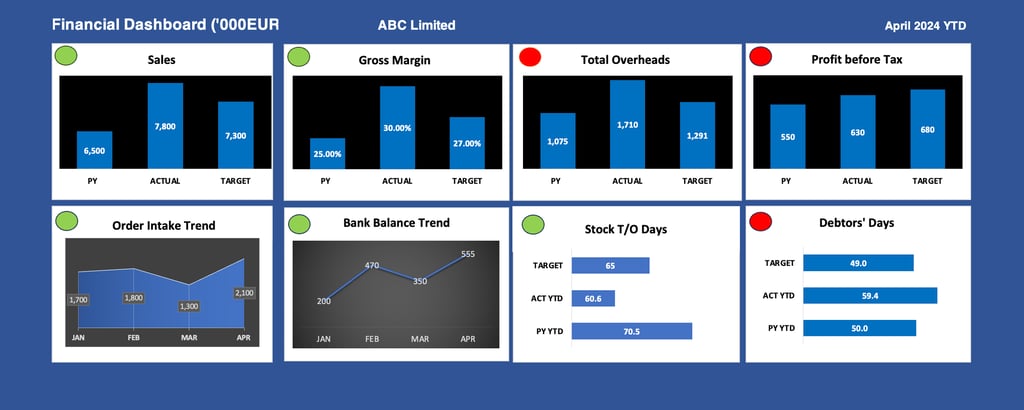
I work with clients to create what I call "Finance on a Page." 5 - 8 key numbers that tell you:
How the business performed last month (versus budget and previous year)
What's working
What needs attention
Something you can review in the time it takes to drink a coffee. Clear enough that you know exactly what to do next.
When you have that, the avoidance disappears. Because you're not dreading reading long reports and trying to decipher what it's all telling you. Instead you're just checking in.
Trends
A lot of businesses I work with are complex with multiple products and services. Their accounts are sometimes too simplified just showing an overall company gross margin or way too detailed showing page after page of performance per product.
Regularly I find underperforming products lumped in hiding the fact that they are being substituted by higher performing products.
The data isn't clear so nothing is challenged and this profit leak continues....
A simpler way to keep a handle on this each month is to view the margin trends of products / product groups or services on a single page . Quickly able to spot each month, which product needs addressing and adjusting.
Look forward
Most financial data I see in businesses are focused on telling the past. Yes that's important, but the real driver for success is using your numbers to look to the future and drive questions and decisions that will strengthen your business. Implementing a Rolling Forecast helps you to see what impact that the decisions you are making today will have on your profit in 12 months time.
New hires, more space, additional products, increased marketing - instead of these being standalone numbers integrating them into a rolling forecast shows the impact on future profit.
Sales not performing as planned or margins slipping - a rolling forecast will clearly show you the gap needed to make up elsewhere to meet your desired profit.
Performing ahead of expectation - great but don't wait until the end of the year to realise the impact. Knowing this ahead may mean that decisions you were delaying can be made earlier - investment into AI and automation or more R&D can be taken this quarter instead of later and the benefits realised earlier.
And as with everything else - your rolling forecast should fit on one page so its simple and clear for everyone.
Timing
The last step I'll leave you with today is timing. Typically I see two scenarios here: business owners waiting until year end accountants give them their final profit or monthly accounts arriving months after the end of month.
Neither serve you to make quick decisions that grow your business. Monthly is the minimum you should see your numbers so that you know whether the decisions being made are having the right impact.
Every month you miss this unfortunately will cost you money. Aim to receive your figures by at least the 10th working day and if it's taking much longer there are typically a few reasons I see for this:
Reporting is far too detailed and complex. Simplify the reporting - what is the minimum data you need to see each month to make decisions - think Finance on a Page approach.
Some information is missing. This will always be the case so can you put in a good estimate or reorganise things so this information comes earlier.
Data inputting is too time consuming. Check with your software provider what parts of the data inputting can be automated. Still I see many businesses investing in good quality software yet only using less than half of the capability. Spend less time on data input and more time on analysing the results - that's where the value is for the business.
Ask Yourself
How would I feel if I had my numbers at my fingertips each month and could quickly see what needs attention? Would that bring peace of mind and better decision making in my business?
Even if you start to implement one of the steps above your numbers will become a help in growing your business rather than another report to check.
And feel free to contact me if you need some help setting this up with your team - I've put some more information here of how I am helping other business owners implement this.
I'm a strong believer that seeing your business clearly changes your decision making and results in a stronger more successful business.


Sharon Kearns
Business Growth Consultant.
Commercially minded, calm under pressure, and honest in my advice. I work closely with founders and leadership teams to bring clarity, confidence, and results.