How to Spot Profit Leaks Without Reading a 40-Page Report
6/25/20254 min read

Drowning in Data — or Starving for It?
Why most financial reports don’t help — and what you should really be asking for
When I start working with business owners, I usually find one of two extremes:
👉 On one side, there are those who receive very little regular reporting — often waiting until their year-end accounts to find out whether they made a profit… or a loss.
👉 On the other side, there are those who receive overly detailed monthly reports that feel like they were written for their accountant, not them.
Both are a problem.
Let’s start with the first.
No Regular Reports = Running Blind
If you're not getting timely, meaningful updates on your numbers, you’re likely relying on gut instinct and firefighting to run the business. That brings stress, uncertainty, and poor decision-making.
These are the kinds of questions that creep in:
Can we cover the next tax bill?
Will payroll go out this month?
Can we really afford the new hire?
Why are we busier than ever but it is not showing in the bank?
This isn’t about “being bad with numbers” , it’s about not having the right ones, in the right format, at the right time.
Too Much Data = Missed Priorities
But the opposite extreme is just as risky.
I’ve seen monthly packs that are 40+ pages long, full of tables and accounting jargon that make even seasoned business owners switch off. Some clients feel they should understand it, but don’t. Others spend hours combing through it but still miss the bigger picture.
And here’s the real danger: when the numbers are too complex or too broad, everyone interprets them differently.
One business I worked with had a slick reporting pack and fancy dashboards but in every management meeting, the leadership team walked away with completely different priorities. Once we stripped it back to a one-page KPI dashboard and a short executive summary, the difference was immediate: shared focus, faster decisions, and a lot less confusion.
What You Actually Need
You don’t need more data, instead you need better clarity.
Here’s what I recommend:
✅ A one-page monthly dashboard
Built for visibility, not compliance. Think of it as the scoreboard for your business.
Include just 6 to 8 key metrics that actually matter to your business. These will vary by company, but might include:
Monthly sales / sales orders
Gross margin %
Overheads
Stock turnover ratio (how quick your stock is moving out the door)
New customer count
Debtor days (how fast credit customers pay)
Headcount
Net profit
Bank balance
Each KPI should show:
Year to date
Compared to same period last year
Compared to budget
Add a traffic light system so you can instantly spot where action is needed.
Add: A One-Page Executive Summary
I've included a simple dashboard below so you can see what this looks like.
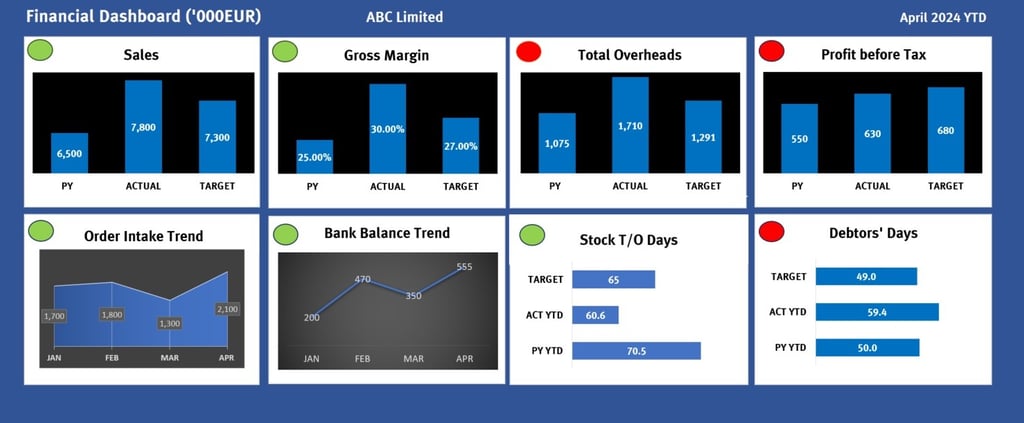
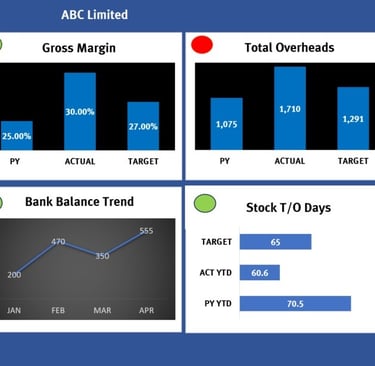
At a glance, you know how the business performed — and more importantly, everyone in your team sees the same story and draws the same conclusions.
But to really unlock value, I always recommend pairing your dashboard with a one-page executive summary.
This is where the real insight lives. It’s where the numbers become decisions.
Instead of just showing that sales are 10% behind last year, a good summary might say:
“A key customer who accounted for 25% of sales last year didn’t reorder. But you brought in new customers that recovered 15% of that decline.”
Or:
“You discontinued a low-margin product that made up 20% of last year’s sales — but your core offers have grown 10%.”
Or:
“Stock turnover dropped because you made a bulk purchase to secure supplier discounts. The impact will level out over the next quarter.”
It answers the question every business owner is really asking: "Is this expected and what do I need to do next?"
Don’t Forget: A Rolling Cashflow Forecast
If cash is tight - or even if it just feels tight - ask for a rolling 3–6 month cashflow forecast.
It doesn’t need to be perfect. It just needs to highlight pressure points early so you can act well before they become a crisis.
Worst case? You get to act early. Best case? You sleep better knowing your cash looks healthy months ahead.
Quarterly: Three Reports That Make a Real Difference
In addition to your monthly reporting, I recommend reviewing these every quarter:
Profitability by product/service line Spot where margin is slipping - or where you should be doubling down.
Forecast to year-end Gives you a forward-looking view of your P&L based on current performance.
Slow-moving stock report Highlights where cash is tied up in dead inventory - before it turns into forced discounts to get it off your shelves.
🔍 Self-Check: Is Your Reporting Actually Helping You?
Take 60 seconds to reflect. If you say yes to 2 or more, it might be time to simplify and realign.
❑ I wait until year-end to find out if we made a profit (or loss)
❑ I don’t get monthly reports I can understand at a glance
❑ I avoid reading the reports — they’re too complex or too long
❑ Our team often disagrees on what the numbers actually mean
❑ I’m unclear if we can comfortably cover payroll or tax
❑ I can’t name the top 5 KPIs we track each month
❑ I get surprised by results I thought were on track
❑ I don’t have a cashflow forecast for the next 3–6 months
❑ I’m not confident in the financial direction of the business
What Your Score Means:
✅ 0–2: You’re in good shape — just keep it consistent
⚠️ 3–4: Time to fine-tune how you’re seeing your numbers
🚨 5+: You’re likely flying blind or overwhelmed — let’s simplify
Final Word
To sum it up, what I recommend is simple yet powerful:
A one-page KPI dashboard
A one-page executive summary to explain what’s behind the numbers
Quarterly trend and forecast reports to help you stay ahead
You should be able to get a clear picture of how your business is performing in the time it takes to drink your morning coffee.
Because when everyone’s working off the same clear view of the numbers - that’s when real progress happens.
👋 Interested to See What This Looks Like?
If you’re wondering how your reports stack up, I offer a light-touch Dashboard & Summary Review - a quick look at what you're currently seeing each month and whether it's helping or hurting your business clarity.
No jargon, just practical feedback you can act on.
Email me a sharonkearns@sgk.ie or book a call here to discuss more https://calendly.com/sharon-kearns/30min-1
Sharon Kearns
Business Growth Consultant.
Commercially minded, calm under pressure, and honest in my advice. I work closely with founders and leadership teams to bring clarity, confidence, and results.